
Over the past year, “GEO” (Generative Engine Optimization) has been sold as a new discipline. New files, new formats, tricks that “convince” AI. When I look at it as an SEO, I see something different: AI assistants run a search before they write an answer. And the way to be visible in a system that searches is still SEO.
I am not the only one saying this. In its official guide published in May 2026, Google says that optimising for generative AI search is “still SEO”. In this article I explain why, with a test I ran on my own name and with the layer that really decides the outcome: the entity.
How does an AI know about a brand? #
A language model can know about a brand in only two ways.
- Training data. The model learns from a large copy of the internet. That copy is months old and cannot be updated from outside. A new brand is either missing from this memory or very weak in it.
- Live search. When a user asks a question, the model searches the web, reads the pages it finds and writes the answer from them. The technical name is retrieval-augmented generation (RAG).
There is no third door. A question I hear often is: “If I tell a chatbot about my brand, will it recommend it to other users?” No. What you say in a chat stays in that chat. The model will not tell another user, “someone told me about this brand the other day.”
In practice, the meaning is simple. For a new or small brand, the only realistic route is live search. And live search means a search engine.
AI search starts with an ordinary search #
Before an AI assistant writes an answer, it searches like a person does. Google says this openly: AI Overviews and AI Mode are built on its core ranking and quality systems. They split a complex question into several smaller searches. This is called query fan-out.
So the rule does not change: a page that is not in the search results will not be in the AI answer either. The only thing that changes is the question “which search results?”
- Gemini and Google’s AI features rely on Google’s own search systems.
- ChatGPT uses its own crawler, OAI-SearchBot. According to OpenAI’s documentation, sites that block this bot will not be shown in ChatGPT search answers.
- Perplexity builds its own index with its own crawler, PerplexityBot. Perplexity’s documentation says this bot is designed “to surface and link websites in search results”.
- Copilot grounds its answers in Bing. Microsoft’s documentation says Copilot sends generated search queries to Bing.
So each AI looks at a different set of search results. A site that does well in Google will not automatically be found in Perplexity.
Query fan-out also creates an opportunity. A question like “best technical SEO consultant” can turn into several narrower searches in the background. You do not need to be on page one for the main keyword. If you are strong in one of the smaller searches, you can still be cited. The work is still SEO, just across the whole topic rather than one keyword.
Entity: does the AI know who you are? #
Being found is not enough. To be recommended, the AI has to identify you correctly. This is the entity layer: working out which person, brand or company a name belongs to.
I tested this with my own name. My site went live in October 2026. I asked three AI assistants the same question: “Who is Sedat Pehlivantürk?”
| AI assistant | First try | Second try | Source shown |
|---|---|---|---|
| ChatGPT | Identified me correctly | — | My site + my contributions on a professional association’s site |
| Gemini | Identified me correctly | — | My site + my contributions on a professional association’s site |
| Perplexity | Described a different person with a similar name | Identified me correctly | Only my Gravatar profile |
Perplexity’s first answer is a typical case of entity confusion. In its index, the strongest sources carrying my name were social media profiles, and they were not about me. At the time, my site was not ranking in Bing yet. ChatGPT and Gemini, on the other hand, connected my site and my contributions on a professional association’s site, and found the right person.
Then I checked Cloudflare’s AI crawler report. My site does not block any bot. Over the last 30 days, the numbers looked like this:
| Crawler | Used by | Requests (30 days) |
|---|---|---|
| Bingbot | Bing, Copilot | ~80 |
| Googlebot | Google, Gemini | ~60 |
| OAI-SearchBot | ChatGPT search | ~50 |
| Applebot | Apple | ~10 |
| PerplexityBot | Perplexity | 0 |
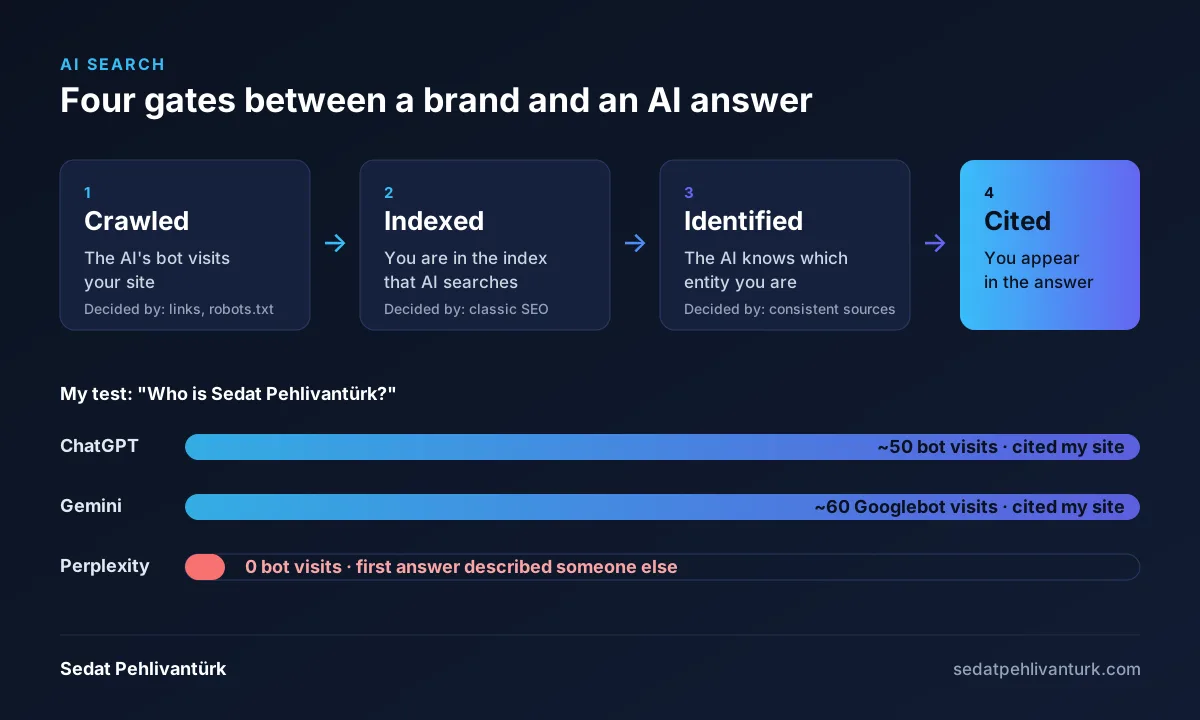
This matches the test exactly. ChatGPT and Gemini, whose crawlers visit my site, identified me correctly. Perplexity, whose crawler never came, mixed me up with someone else. Leaving the door open is not enough; the bot has to come in and add you to its index.
So how do you get a bot to visit? There is no “submit your site” button for OAI-SearchBot or PerplexityBot. Crawlers find your site through links on pages they already crawl. For Bing you have Webmaster Tools and IndexNow. For the others, the only way is to be mentioned and linked on other sites. Even attracting AI crawlers comes down to classic SEO: discoverability and links.
The difference is whether sources confirm each other. When several independent sources describe the same person in the same way, the model can build an entity. When there is only one weak source, someone with the same name can come out ahead.
What a strong entity needs is not new:
- Complete profiles. Every profile that describes the brand or person (LinkedIn, Gravatar, GitHub, industry platforms) should carry the same name, the same title and the same expertise, and link back to the site. In my test, Gravatar was the only source Perplexity found. If that profile had been empty, it might not have found me at all.
- Structured data. Person or Organization schema, with
sameAslinks to those profiles. This is the machine-readable way of saying “all these profiles are the same person”. - Being part of the topic. Being cited on relevant sites through articles, contributions and quotes. In my test, what brought the right answer was my contributions on a professional association’s site.
None of this is “AI-specific”. It is the same thing Google has asked for its Knowledge Graph for years.
What do “GEO tricks” actually do? #
Most of what is sold as GEO is either old SEO with a new name or an idea with no proof behind it. Google’s guide addresses several of them one by one.
- llms.txt. Google says you do not need llms.txt, special AI text files or Markdown versions to appear in its AI features. It does no harm, but it will not get you recommended.
- Chunking content into small pieces. Not needed. Google says its systems can understand several topics on one page.
- Special schema. There is no special schema type for AI. Schema is still useful, but because it defines the entity.
- Fake brand mentions. Google says seeking inauthentic mentions is not as helpful as it might seem. My test showed the opposite path: what worked were real contributions.
- Hidden instructions on the page. Adding text that people cannot see, to steer an AI, is not a ranking tactic. It is spam.
The Agentic Browsing section in PageSpeed Insights is also often misread. It arrived with Lighthouse 13.3 in May 2026 and is still under development. It checks the accessibility tree, layout shift (CLS), WebMCP and llms.txt. Its purpose is to help an AI agent move around a site and fill in forms. It is not about whether an AI recommends you, and Google has not announced it as a ranking factor.
In short: being found and being recommended are SEO and entity work. Agents being able to act on your site is a separate technical topic.
How do you measure it? #
There is no single ranking report for AI visibility, but you can measure the parts.
- Bing Webmaster Tools, AI Performance. Shows which of your pages are cited in AI answers on Bing. Topics Portfolio (Beta), added on 13 October 2026, also lists queries where other sites are cited and yours is not.
- Google Search Console. Because Google’s AI features are built on its core systems, organic performance is still the best signal.
- Analytics. Referral traffic from ChatGPT, Perplexity and Gemini.
- Server or CDN logs. Are crawlers like OAI-SearchBot and PerplexityBot visiting the site?
- Regular prompt tests. Ask the same questions at set intervals and record the answers. AI answers change, so do not read one answer as a permanent ranking. In my Perplexity test, the same question gave two different results on two tries.
A short checklist #
- Can AI crawlers reach your site? Check robots.txt and your CDN’s AI bot settings.
- Is your site indexed in Bing as well as Google?
- When you search for your name or brand, does the AI match you with the right person or company?
- Do your site, profiles and external sources describe the same identity? Are your
sameAslinks in place? - Do you say something that cannot be found anywhere else? Google calls this “non-commodity content”.
- Do you have real contributions on other sites?
GEO may be a new name, but the work is old. Make sure search engines can find you and identify you correctly, and AI will find you too.