
It sounds like an exaggeration. It isn’t. A brand search feels safe precisely because the results almost never change — and that stability is exactly what an attacker exploits. In this article I’ll walk through, step by step, how a phishing site plants itself inside the search results of an established brand. Not from theory, but from what I’ve observed on the defensive side for some time.
Why brand search results are hard to break into #
If you have an established digital footprint, your brand search is actually a very calm place. Search engines recognise your brand as an entity: domain history, backlink profile, brand signals and user behaviour all combine, and the results page barely moves outside of a few predictable conditions.
That stability is a wall for the attacker. Getting a pixel-perfect phishing clone to rank organically for your brand term is close to impossible — because algorithms work out very quickly that it’s a clone. The rest of this article is about how that wall gets climbed anyway.
The clone nobody is allowed to see #
Picture a financial scam. The first step is a one-to-one clone of the target brand’s site — visually indistinguishable. Next to it, the attacker registers a domain that evokes the brand’s name — something like secure-examplebank-login[.]com or examplebank-verify[.]net, to use harmless, defanged examples.
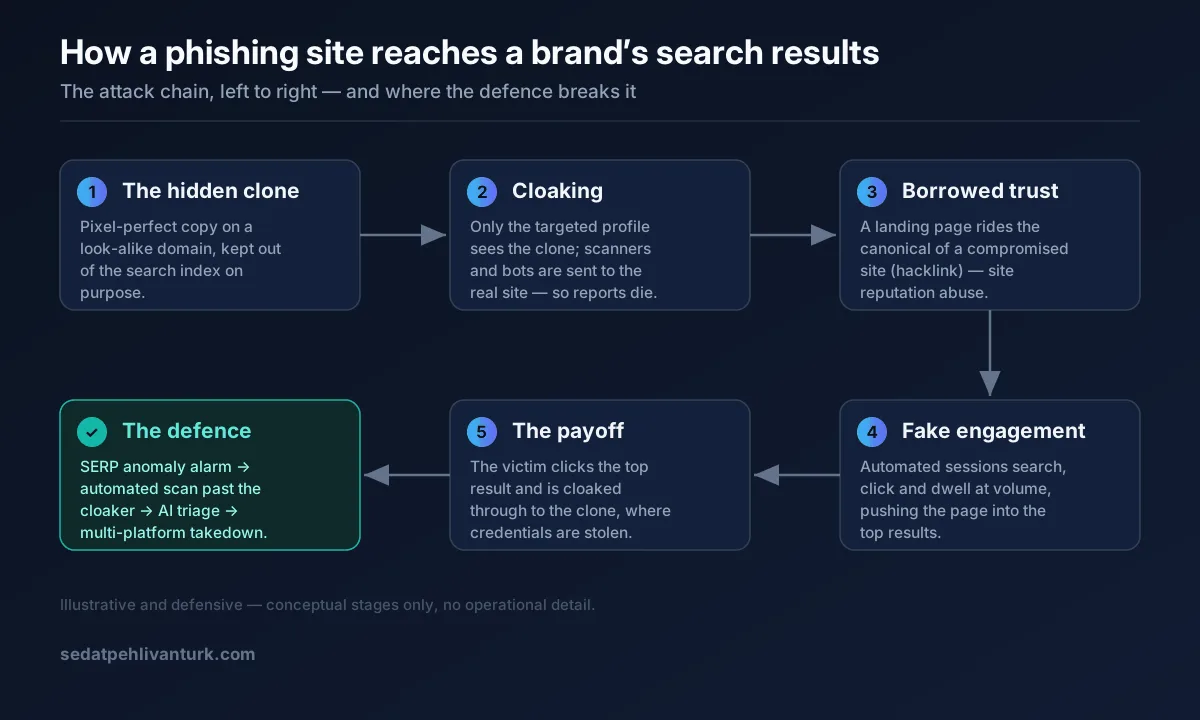
But this clone never tries to rank. On the contrary, it’s deliberately kept out of the index. On top of it sits a cloaking layer (known in the field as a cloaker or shell). That layer sorts visitors: only the targeted profile — a specific device type, a specific location — reaches the real clone. Everyone else (bots, security scanners, traffic from the wrong country) is quietly redirected to the brand’s genuine website.
Notice why this paralyses the defence. When an automated scanner arrives to check the site after an abuse report, the cloaker sends it to the real bank — so it concludes “nothing wrong here, this is a legitimate site,” and the report dies. By controlling visibility, the attacker controls detection.
Borrowing trust: site reputation abuse #
If the clone can’t rank, how does it reach people? Not by email or SMS — through the search result itself.
A separate landing page is built; its domain is again close to the brand, or the brand name is padded with words like “login”, “secure” or “vip”. That page is then dropped into the canonical tag of a compromised site bought on the black market (in the trade this is usually called a hacklink). Google’s own spam policy has a name for the underlying abuse: site reputation abuse.
The logic is this: the compromised site is old, established and trusted. When a page declares via its canonical tag “my real content lives at this address,” the search engine tends to extend trust to the address it points to. So trust is siphoned from a legitimate site and transferred to the phishing page. To speed things up, bulk backlinks are pointed at it too, and the page suddenly surfaces for the brand term — though usually on the fourth or fifth page.
This “borrow someone else’s trust” pattern isn’t a one-off. Security researchers have documented the same mechanics repeatedly in large-scale campaigns, including operations that turned compromised institutional sites into ranking weapons. It’s an established method, not an edge case.
Manufacturing demand: fake engagement #
Who clicks a link on the fourth page of a brand search? Nobody. And that’s the real problem the attacker has to solve.
Enter fake engagement — automated click farming, known in the field as hitbots. Automated sessions that imitate a real user go to the search engine, type the brand name, find the phishing link among the results, click it, and then move around the page like a genuine visitor. When those signals are produced at enough volume, the algorithm reads the page as “a result people search for and find useful under this brand term,” and lifts it up. Within a short time it settles into the top positions of the brand search you run every day.
I’m deliberately not detailing how those sessions are built. The goal here isn’t a recipe — it’s to make the mechanism detectable.
The payoff — and why it’s so hard to kill #
Now the chain is complete. The user searches for the brand as they always do, clicks the top result, the cloaker routes them to the clone based on their profile, and they hand over their credentials believing they’re logging into “their own bank.”
This is not a niche problem. In 2025 alone, losses reported to the FBI’s Internet Crime Complaint Center passed the 20-billion-dollar mark, and phishing/spoofing was the single most-reported crime type across every category (FBI IC3 2025 Annual Report).
Here’s the awkward part. A site ranked this way doesn’t last long — algorithms usually catch the mistake and drop it within three or four days. That might sound like good news. But for a high-traffic brand, those three or four days are a disaster. “Wait and hope the algorithm corrects itself” is not a defence. You need something faster.
Building a search-forensics early-warning system #
My approach was to turn this into a system rather than chase it by hand.
Continuous SERP monitoring. I built monitoring that queries the results page for brand terms relentlessly and tracks the position of my own site. Because an established brand’s SERP is stable, every deviation is meaningful: if the site drops a few places, or an unfamiliar domain plants itself in the top five, that’s an anomaly.
Anomaly to alarm. On such a deviation, the system raises an alarm. That could be wired to a notification or an email — but I connected it to full automation: the alarm triggers the next step without asking a human.
Automated inspection — and beating the cloaker. The moment the alarm fires, a process starts scanning the suspect site: source, HTML, DOM. There’s a critical obstacle here. A good cloaker can recognise my scanner and throw it a harmless decoy page. To get past that, I repeat the scan under conditions different from the “clean” profile the cloaker expects — the aim is to see the page a real victim sees.
Classification with an AI agent. I pass the scan data to an AI agent I’ve trained for this job. The agent isolates the suspicious and malicious patterns on the page and makes a call: is this a phishing page or not.
Multi-channel reporting. If the answer is yes, the system opens the abuse action — notifying roughly 22 platforms via API, including Cloudflare, Google Safe Browsing and PhishTank.
With this flow I’ve taken down close to 500 phishing sites — not one by one by hand, but as a line that runs itself from alarm to report.
Of course it doesn’t solve everything. Sometimes even three or four days is a luxury; when an immediate response is required, manual abuse reports through Cloudflare — which can produce results in around ten minutes — come into play. But that deserves an article of its own, so I’ll leave it for the next one.